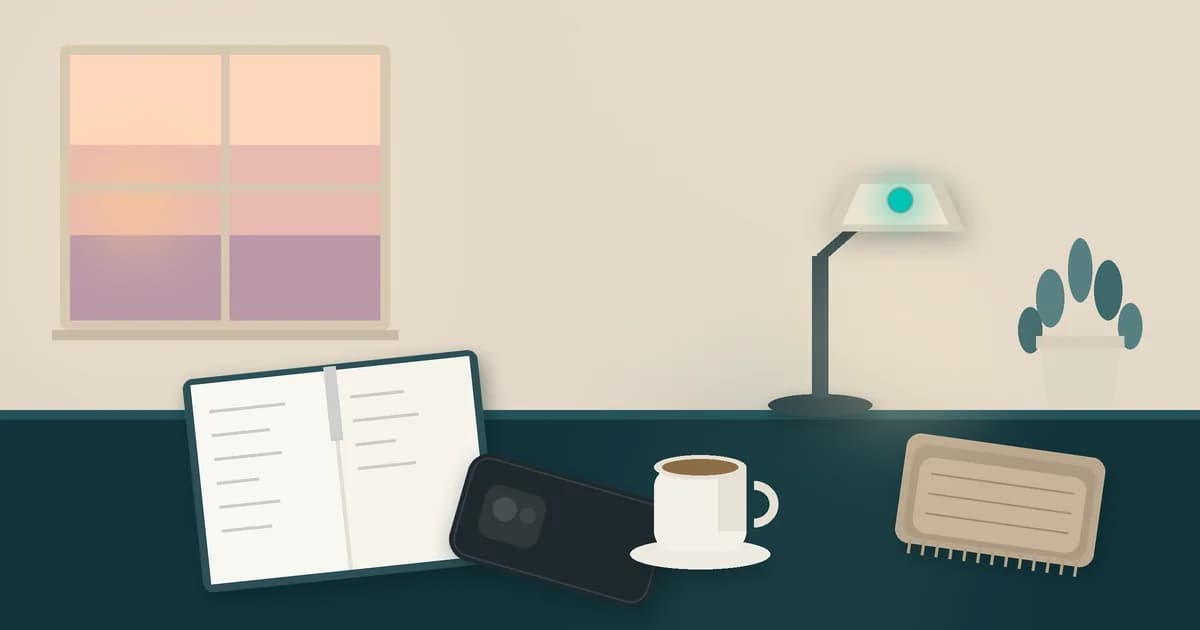
A simple evening wind-down routine is a short, repeatable set of calm steps: put the screen down, soften the room, move gently, and note what's left for tomorrow. It gives the day a clear end. It isn't a sleep treatment and it doesn't promise better nights — only a calmer close.
Lifestyle guidance only; it isn't medical advice. See our Health Supplement.
Why a routine helps
A wind-down is a cue that the day is done. When work, messages and bright screens keep going until you fall into bed, the evening never really ends. A short, familiar sequence — same order most nights — makes it easier to leave the day where it belongs. Keep it light: no hour targets, no scores, and nothing that has to be perfect.
A 20-minute wind-down in 5 steps
- Close the day's screens and work. Shut the laptop, put the phone face-down, and leave open tabs for tomorrow. "Just one more" is how evenings disappear.
- Soften lights and tidy one surface. Dim a lamp or switch off the brightest light. Clear one small surface — a desk corner or the kitchen counter — so the room feels finished.
- Move gently. A short indoor walk, easy stretches, or rolling your shoulders. Nothing should hurt. Save intense exercise for earlier in the day; late intensity fights the wind-down.
- Write tomorrow's top 1–3 things. Park what is still on your mind so it doesn't keep looping. If the list gets long, move the rest to a "not tomorrow" line — the same idea as planning a lighter day.
- Choose one quiet activity. A few pages of a book, soft music, or breathing slowly for a minute. Pick one, not three.
Short version for tired nights
When twenty minutes feels like too much, use this ten-minute version:
| Minutes | Step |
|---|---|
| 0–2 min | Put screens face-down; close work tabs |
| 2–4 min | Soften one light; tidy one surface |
| 4–7 min | Gentle stretch or a short slow walk indoors |
| 7–10 min | Write tomorrow's top 1–3 things; one quiet minute |
On those nights, picking one step still counts. A short close is better than skipping the close entirely.
Use the evening to check your day's Load
Load is what the day asked of you: work, errands, people, decisions, and what you carried in your head. It's one part of Rest · Move · Load. Before you finish the wind-down, ask: was today light, okay, or a lot? Did you get any rest or movement? What one thing belongs to tomorrow, and what can wait?
No scores and no judgment. If several heavy days have stacked up, that is a good moment to read how to know if you need a rest day. And if most of your day is at a desk, ideas for staying active with a desk job fit into earlier hours so the evening can stay gentle.
Common ways a wind-down goes wrong
- It gets too long. A routine that takes an hour becomes another chore. Keep a twenty-minute default and a ten-minute fallback.
- It gets too strict. Missing a step is fine. The goal is a clear end, not a perfect checklist.
- Intense exercise late. Hard workouts belong earlier. Evening movement should feel easy.
- "Just one more" scroll. Opening the phone for a notification often turns into twenty minutes. Face-down is the rule for a reason.
Where MoveMe fits
MoveMe is the health and wellness app in Blackwhale PersonalManager, built around a simple Rest · Move · Load balance. Rest makes recovery visible, Move keeps everyday activity in view, and Load helps you reflect on what your day asked of you. Looking back over a week, it's easier to see which evenings felt rushed and where a calmer close would help. MoveMe uses the same Shared Login as the other PersonalManager apps.
MoveMe offers lifestyle guidance only; it isn't medical advice or a medical device, and it doesn't diagnose or treat anything.
FAQ
How long should an evening wind-down take?
Twenty minutes is a comfortable default. On tired nights, ten minutes is enough. The point is a clear end to the day, not a long ritual.
When should I start the wind-down?
Pick a time that fits your evening and keep it roughly the same most days. A short cue — closing the laptop, dimming a lamp — helps more than a perfect clock time.
What if I still can't switch off?
Keep the routine short and gentle, and write tomorrow's top one to three things so they aren't bouncing around. If sleep problems continue, talk to a doctor.
Do I need an app for this?
No. A notebook and a phone you put face-down work fine. An app can help you notice Rest, Move and Load over a week, but the routine itself doesn't need one.
Is this medical advice?
No. This guide is lifestyle guidance about ending the day calmly. It isn't medical advice. For ongoing sleep or health concerns, talk to a qualified professional. See also our Health Supplement.
Give the day a calm close
See how MoveMe helps you keep Rest, Move and Load in one calm view: Try MoveMe